Thursday, November 06, 2014

Remembering Dad ...

Once in a while, you become emotional, you feel like crying. Later on, you may think you were being irrational then. So what? It is better to cry, the psychology research has shown and we'd have cried even if that were not the case.

Today is such a day and now is such a time. I sob as I write this blog post. My dad passed away exactly 12 years ago. I was in the US and he was back in India. It was quite an unexpected heart attack. He was watching a cricket match in his usually excited self and then went upstairs for some chore and was not to return.

He was a straightforward man, a common man just like you and me. You are not fortunate or unfortunate to be a man's son. He is a part of yourself, your memories, your identity. The glory is not necessarily in anything particular you got (or did not get) from him, it is in the time you spent together. It becomes part of your past forever. The fact that you won't ever receive a visit, an email or a phone call from him makes that past precious. An unforgettable past may not be true in everyone's case, but perhaps it should be.

You become a better son when you become a dad. It certainly is true in my case. I am fortunate to realize this when my son and daughter remember their grandfather, the grandfather that they have never seen. Time and again I am reminded of this mystic quote:
Death is a part of life, not the end of it.

Tuesday, September 23, 2014

How Kids Teach Adults ...

I consider myself an observing, learning adult. Thus, I make mistakes, observe consequences and make amendments if I am able to overcome the prejudice (and maybe fear). The bad thing then is that I am vulnerable to making mistakes. The good thing however is that I have a chance to improve (when measured in some objective way). Overall, life is good!

A central tenet of the environment that is conducive to such learning is, of course, Freedom. Without going into too much detail of the concept of Freedom of thoughts and actions (it is complicated if we let it to be), let us just say that freedom is at its best when given. So, basically, you let things happen on their own (technically: laissez-faire) even when you could have made them happen in a specific, premeditated manner by coercion.

One of the best experiences of this is to be had when you are with kids. If you cultivate an environment where they are free, you get to see the glimpses of an interesting nature of freedom: accidental discovery. Some call it the serendipity. Here is a somewhat routine, everyday experience with two siblings (Nachiket: Boy, 9 and Gargi: Girl, 5) with their dad (Baba) as he was dropping them off to school (in the United States). The other character referred to in this short narrative is the kids' older cousin (Sharada: Girl, 20).

Nachiket: "Dad, are there no rules in college?"

Baba: "Who told you that?"

Nachiket: "Umm, we talked to Sharada this past weekend and she was saying ..."

Baba: "Ah, I see. Yeah, I remember, you became very interested when Sharada said that they had no rules in college and was jokingly urging you to join her in college. Hmm, well, there are rules in college, but perhaps they are fewer than those at school."

Nachiket: "Why are there rules [at all]?"

Baba: "Well, they believe that there would be chaos without them. Simply put, there are rules because they need to manage the students effectively. These fifty students have fifty different personalities, so they [teachers, staff] need something that fits all to manage them effectively. And they think that making rules would make it easier to deal with those students."

Gargi: "I'd like to go to college soon."

[Just then, a beautiful, beautiful rendition of Ram's life, called Geet-Ramayan, started playing on the phone. Of course, Nachiket was the motive force behind it. This was a favorite pastime of Nachiket and Gargi: when in car, listen to the songs from Geet-Ramayan, even when they don't understand the meanings of the words and their relevance. Describing the melody G.D. Madgulkar (the great Marathi poet), Sudhir [Babuji] Phadke (the great Indian composer) and others have created in 1956 is beyond my literary capacity (or incapacity). These kids listen to those songs all the time, on their own. This, to us parents has been a mystery and a pleasant surprise. The song being played at this time was "नको करुस वल्गना, रावणा निशाचरा" -- "Hey (nocturnal) Ravan, Don't be excited (at your success)". This song is sung by a distressed and abducted Sita.]

Baba: "Do you know what "sur" [in the song] means?"

Gargi: [Without talking a word, starts singing herself] "Saaaaaaaaaaaaaaa" [this is the 'do' tune in 'Do-re-mi-fa-so-la-ti-do' and it is true. One of the many meanings of that word "sur" is "a particular fre‌quency, note in music". The dad was so surprised to experience this  accidental 'connecting of the dots' done by his 5-year-old!]

Baba: "You are absolutely right! "sUr" means exactly that -- a note in music. Good job! However, "sur" means something different. Here, it means "god". But I am really glad that you found that meaning, Gargi!"

This short narrative is yet another eye-opening for experience for me. This is exactly how I believe kids (and perhaps adults too, if they let go of the curse of knowledge) learn.

Should the schools too have such freedom that Daniel Greenberg has been trying to bring about? Is that practical? If not, why not?

Saturday, February 01, 2014

The Contrast ...

I reached the Sunnyvale train station. The 7.13 northbound fast train was late. There was a fatality in the Redwood City area. I boarded the next train. I always board the first bike car. Since this was an unusual day, many announcements were being made. The conductors were alert and helpful. There was only one line that was now shared between the southbound and the northbound trains. People were upset that they were being late to offices apparently for no fault of theirs. Impatience and intolerance aggravated.

Redwood City approached. A conductor was standing right behind me. She was curiously looking ahead but said, "I wouldn't look, they are collecting the pieces now". Those were the organs of the woman who was struck and killed by a previous northbound train. A train staff was collecting in a plastic bag a pair of boots, a set of hair, torn clothes, a human finger, perhaps parts of a human eye ... The crew was at work, it was work for them as usual. My train passed this silent drama slowly, with me watching it solemnly, disregarding the conductor's advice.

The life came back to normal. Perhaps it had to. The complainers were pacified one way or the other. The train reached its final destination. Clear skies, fresh breeze and joyful city life greeted me. I biked to work and resumed my daily activities almost as if nothing untoward had happened. Yes, the show had to go on.

Someone has said, "Death is a part of life, not the the end of it." Why is it then that this experience makes me pause and reflect? 

Thursday, July 25, 2013

Java Generics: Technical Book Review

This post is a book review (as part of O'Reilly Blogger Program) of the following book:
  1. Name: Java Generics
  2. Authors: Maurice Naftalin, Philip Wadler
  3. Released: 2006
It's perhaps too late to be reviewing this book, as technical books quickly become outdated. The book was written at the time of a Java release that  marked the "new beginnings" of the formidable Java platform, the Java 5 release, back in 2005. This book review is written in 2013. Generics are an inseparable part of Java Programming Language. Though you'd like to think that it were (somehow) optional to know Generics, it's not the reality. You must be thorough with Generics. I agree that not all of us are library or API designers/implementors, but all of us are users of Java API; and a well-written, "modern" Java API uses Generics heavily. As a result, it quickly becomes imperative to know what Java Generics are.

And if you want to understand Generics, this is the book to get and read. Look no further. The treatment of Generics has not changed (and perhaps will not change) across Java releases. What was true in 2006 about them will be true for quite some time (with minor improvements). And both Naftalin and Wadler have done an exceedingly good job of providing a thorough, lively and almost perfect treatment of this arguably the most divisive Java language feature.

The prerequisite to reading this book (like, perhaps any other book) is to look at both Generics as a concept and their particular implementation adopted by the Java Platform with an open mind. If you have preconcived notions about this (which is not bad), this book is not for you. You should then be on the Java Community Process (JCP) mailing list about Generics.

I appreciate this book mainly because it tries to "inform", not "impress". Many (even popular) technical books tend to do the opposite. With lucid examples, the book helps getting to the bottom of the "whys". It also brings out the synergy between the Java 5 language features that makes the whole greater than just the sum of its parts. After/while reading the book, you might see how the controversial autoboxing/unboxing, varargs methods, the foreach loop work in unison to deliver toward a common goal -- typesafe collections of Java objects.

It's likely that you just hate the compile-time type safety. Perhaps you come from a refreshing and liberal dynamic scripting language like JavaScript and believe that compile-time type safety does not alleviate you of testing your code. You should then consume Generics as a necessary evil when programming in Java. But even then, if you are willing to accept that type safety has some benefits especially in the context of the Java programming language, read this book.

Tuesday, May 28, 2013

Are we becoming devicive?

No, there's no typo. I mean devicive and not divisive (which sadly, we are becoming with all these compartments we tend to create).  But I just coined this word:


devi·cive [dih-vahy-siv, -vis-iv]
Adjective
Tending to show off expensive devices; gadgety
This occurred to me when my son's school had an "after-school electronics party" where they were supposed to bring in a small electronic gadget and share it with it others. They were allowed to be creative in picking such a device. My son is in 2nd grade.

He complained on the day before the party, "Baba, we have this party tomorrow and everyone plans to bring in iPod Touch, iPad, Xbox, Samsung Phone, Nintendo DS, and so on. What should I carry?" I knew that a day like this might come. I just did not know that it would be this soon. I was rather disappointed that at the electronics party, the kids are not bringing in those electronic devices that spark some fun. I didn't realize that Apple gadgets, Android-Samsung smartphones and Nintendo DS's are supposed to make us parents stop thinking :-). Are these devices what we want 2nd graders to think of, when we mean Electronics?


A binary clock
I looked around the house and suggested to him of the gadget that is by his desk and has faithfully displayed the time every time ;) -- his binary clock! It fit the bill and he's always liked it and he was so happy to have made that choice. I was of course proud that I didn't have to make a trip to Apple Store. I was more proud of my son because he spontaneously accepted this suggestion even when peer pressure is not easily surmountable. In fact, later on, somebody told him, "Hey buddy, I liked your binary clock!" and he was very happy!

Don't get me wrong. I did not want to seem different for the sake of being different, nor did I want to suggest that my 2nd grader son knows how to read a binary clock. It was just a sensible choice (I thought) we made when confronted with an unexpected situation (which is what life is all about). I wish I had created (made) a small electronic device along with him, but alas, there was not enough time.

Again, it's not that I hate the devices. I love them. I like creative products that many companies come up with. And I believe that Apple, Sony, Google, Microsoft, Nintendo have done a great job in creating such devices, but I don't think those devices should distort (or conveniently enhance!) our understanding of Electronics -- our 2nd graders' notions of electronic gadgets don't have to start and end with an iDevice.

Sunday, January 13, 2013

RIP, Aaron Swartz ...

Sometimes, some deaths are just gut-wrenching. Aaron's death was one such incident.

Aaron, a master computer programmer, an Internet activist committed suicide at 26. You can read up all about it for the Internet search will find you all the relevant details quickly.

I, like many others, didn't even know about Aaron, the man behind the name, until I read about his untimely death. But in hours of my discovery of his genius, this news and the whole unfortunate aftermath, I was grieving his death like that of my family member.

13 felonies for the crime (!) he committed? All he wanted was a fair treatment of his alleged crime and it was not granted. I shudder even now as I write this. Maybe we should rename justice.gov to law.gov, there's no justice.


Thursday, August 02, 2012

We, the People ...

OK, this is one of those extempore posts, and yes, it comes after a long time. I felt if I did not do it soon enough, I'd probably never do it.

It was a busy Thursday morning like any other. Many tasks, TBD's running down my mind. I was dropping off my daughter at her school. And as it often happens, I was Multitasking. After dropping her off in her room, I saw a teacher from that school, Ms. Gina. She was parking her motorbike! Now, I had seen Ms. Gina several times. She had always been grumpy, or so I thought. Sometimes, I even thanked myself that she teaches kids in another room (not my daughter's).

Out of curiosity, I approached her and said, "Wow, Ms. Gina, I didn't know you ride a motorbike!" Not that everything unusual is great, but I was seriously intrigued. "Well, I have been riding for years now", she said. "Amazing", I said, maybe because usually you are attracted toward something that you have always wanted to do but could never do. "My entire family rides. My brothers (when they were single) were professional riders. I am not a professional, but this is the only vehicle I ride", said Ms. Gina.

I couldn't hide my bewilderment and I wished her a great day ahead and went off.

This is perhaps on the lines of Atul Gawande's five rules for Harvard graduates. Paraphrasing him,
My Rule #1 for you comes from a favorite essay by the writer Paul Auster: Ask an unscripted question. Ours is a job of talking to strangers. Why not learn something about them?
 Many a time, we are under the effects of our preconceived notions. Even if you are not pursuing a career in medicine, a large part of our lives is being actually social. Just a curious observation or question sparked by our genuine interest in things other human beings do can make our life more enjoyable, isn't it? 

Wednesday, May 11, 2011

Consider donating to Tuscaloosa ...

In the aftermath of recent happenings (it's always a mixed bag isn't it?) I am a bit disappointed that Tornado damages at Tuscaloosa are being taken in casual manner. After all, where press is more interested in the Royal Weddings and competitive advantages in political landscapes (international too), this is bound to happen.

Agreed, this is not as mammoth as Japan's tragedy, but hey, tragedy is tragedy. There is no relative scale. Ask who are affected. Ranking mishaps is for those who are not affected by them.

What I am amazed at is there is no easy way to donate what is needed. Maybe I should build one, someday. No, it's important. Donating, let me repeat, what is needed. And who'll determine what is needed? Those who are there, those whose homes and dreams were destroyed by the devastating and indifferent disaster. They are in the best position to decide what kind of help they need at any point in time. Sometimes, they need clothes, other times money (yes, money is not always the best way to get help) or non-perishable food items.

I imagine a website, a web service that lets those who are at the affected areas manage what is needed and let those who are eager to help pick and choose what they can send. In theory this is so simple that I almost want to start coding (writing) this web service. Having a tie-up with places like Amazon would be awesome!

Amazon, the word's most feared marketplace (yes, that's my interpretation of them) does not have anything where I can choose the required stuff and ship where it is needed.

Facebook, the word's busiest social networking website has nothing (that I could easily find) that does what's needed at this hour.

So, we are back to where we were. The human networking where humans appeal for help and they get response. The success is at best measured by number of hearts moved. But the contribution of technology to the management of such mishaps still leaves many things desired!

Well, I am going to do my part and donate the goods required by having them shipped to Tuscaloosa from Amazon.

You can do that too!

Monday, March 21, 2011

The Bear, the movie ...

Every once in a while, something that we see makes us dumbstruck, spellbound. The reason that makes us feel so can be anything, anything beautiful, sad, indifferent. The spellbinding effect can hardly be explained in words.

Nature is one such equalizer, normalizer, cold and devastating, dry and soothing, grand and mean, all at the same time. If human emotion/reason is what you savor at, how about the Nature reason? It's wild because it is free.

If you have not already seen this delicate balance and imbalance of Nature's grand, dramatic deeds, watch The Bear. Look no further. Read no further. Just watch it. Forget about IMDB's lowly 7.6 rating. Rating systems are flawed. They don't tell you what you should be watching. When my friend Byron gave me the DVD, I was far from elated about it. When I finished watching it with my 6-year-old, I couldn't move. James Oliver Curwood's tagline

The greatest thrill is not to kill, but to let live.

could hardly be put on the silver screen in a way better than how Jean-Jacques Annaud has done. Hats off to Jean-Jacques and his entire team. Read his story. He is one of those who make you feel proud of being a human being.


Thursday, December 23, 2010

A Modern Indian Miracle?

So, here is a little quiz for all of you:


What Indian Entity (village, city, district) has the highest GDP in the country?


Nope, it is not a city.

These honors are claimed by a small village in the state of Maharashtra. Its name is Hivre Bazar. It has won a number of awards for bringing about the little changes needed to transform itself into some kind of ideal village. Back in the day, such honors were claimed by another place named Ralegan Shiddi.

The village has a very good website [http://hiware-bazar.epanchayat.in] (hosted in India) which has a wealth of information, if you are interested.

This goes to show that non-participation of governments and spontaneous participation of us, the people, can create miracles in public lives, both rural or urban. Any researcher and worker who has worked in these areas that concern masses should visit this place. I hope to make a trip to Hivre Bazar soon ...


Wednesday, November 17, 2010

A school system of my dreams ...

While wandering (not aimlessly) in the wonderland of WWW, I ran into Joseph Weizenbaum's (The ELIZA creator) thoughts (from 1985) about problems with educational establishment. Read them here first. My modest observation has been that they are applicable today just as well.

Paraphrasing him (bold casing mine):
Q: What are the problems of the educational establishment?

A: The first priority has to be, it seems to me, to lend to those to be educated a mastery of their own language so that they can express themselves clearly and with precision, in speech and in writing.That's the very first priority. The second priority is to give students an entree to and an identity within the culture of their society, which implies a study of history, literature, and all that.

And the third, very close to the second, is to prepare people for living in a society in which science is important, which means to teach them mathematics, or at least arithmetic, and the fundamental skills important to observing the world.

A school system which meets these main objectives might think about introducing something new. Meanwhile, researchers should certainly work on innovative education -- including computer-aided education. But we ought not to use entire generations of schoolchildren as experimental subjects.

In part, this response is based on my belief that what primary and secondary schools teach about computers now is either wrong or can be learned by a reasonably educated person in a few weeks.

Now, I do believe that somewhere, there is truth that unifies all these subjects. But this is pretty close to what I'd like to build, some day.

Monday, November 01, 2010

On problem solving ...

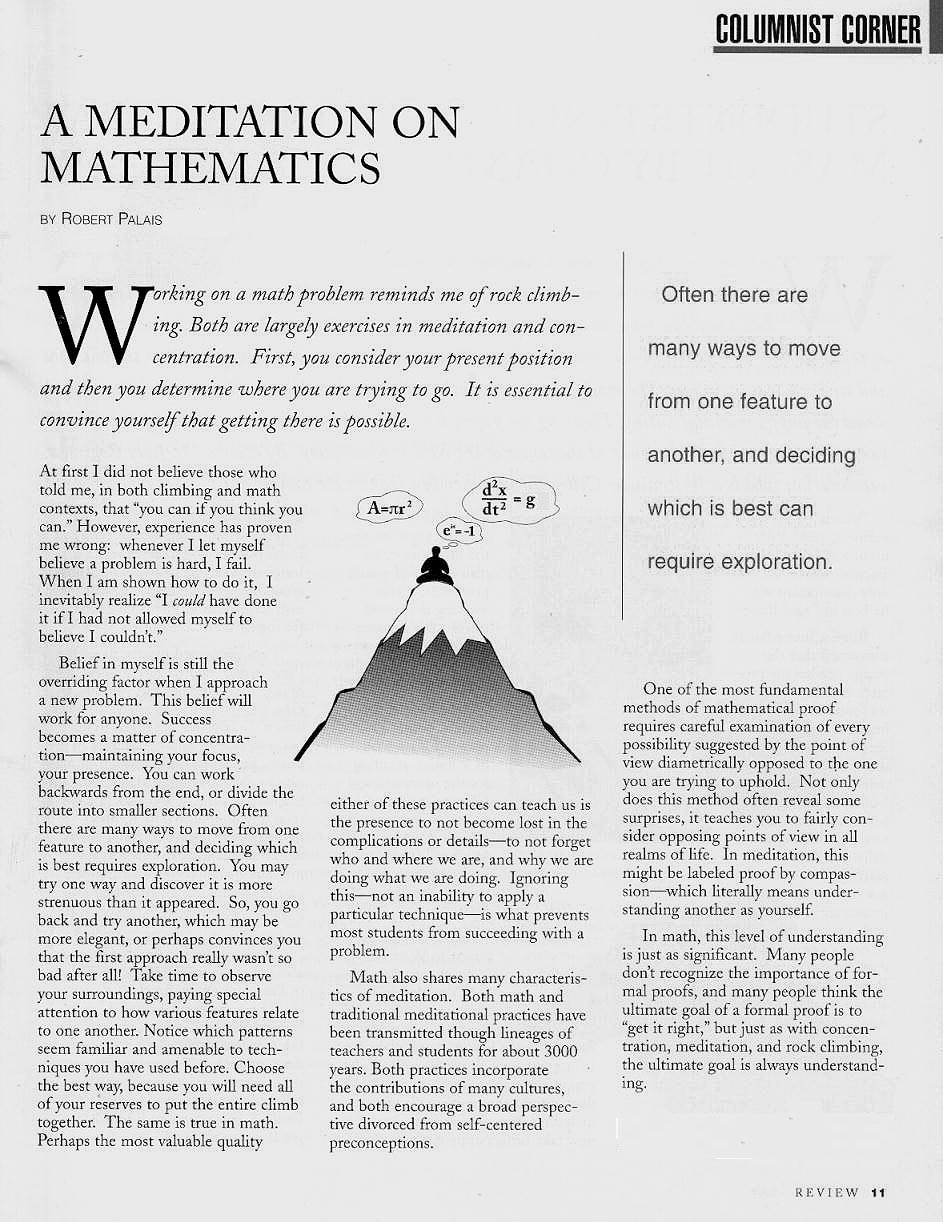
Professor Bob Palais has written an interesting article on problem solving. His arguments are not only motivating, but also enlightening. They make you believe that it is belief that you will be able to solve the problem that plays a major role in actually solving it.

You may wonder if you have the capability to solve it. But here is a simple trick that should help. It has helped me. Let us say you tried (for some time) to solve the problem and got nowhere. Then you read the solution or someone tells it to you. Now, ask yourself if you are able to understand the solution and how it solves the problem. If you really understood the solution, my argument is that you are (and were always) in a position to solve it all by yourself. It is not a silver bullet, but something that has worked for me. Of course, the concentration (that problem solving itself requires) is a must.

My argument can be supported (not proved) thus. If one is not able to understand the solution to a problem, we know that it can be concluded that he or she would not have been able to solve the problem. For example, I don't understand the Theory of Relativity yet and that is evident only because I don't understand the solutions to most of the problems in it.

I understand that converse is not true, but I am not proving anything anyway.

Saturday, October 30, 2010

Serendipity may find you ...

Quite brilliantly, Paul Buchheit wrote Serendipity finds you. I think it may. The definition of the word (the claimed origin of which is itself fascinating) makes the word a matter of chance. One cannot count on making rich discoveries by chance. Being able to plan to make to such a discovery appears more scientific.

Making such discoveries depends on one's nature. A very good friend of mine for instance, hates surprises, by nature. The progress she makes in life is an outcome of careful planning. She enjoys life better that way. I have tried to show her several times that it is OK to do an unplanned activity. Once, she was wondering about how she can get back in shape in her busy life (which involved raising two kids). She spent quite some time thinking about it. And then one day, all of a sudden, I almost dragged her into a bike shop and we bought a bicycle for her. I said she could bike to work, do her farmers' market trips on the bike etc. And she did. It has been three years since that and she has only thanked me about this spontaneous act. It has helped her significantly (although biking on the streets of the Bay Area is not safe for someone like her, or anyone for that matter).

We have talked at length about this and other similar incidences and I think I now understand her plight. Leaving something to chance knowingly is something she just cannot do. Of course, like we make little adjustments to our nature, she could make some provision for accidental discoveries. But I now appreciate that it is hard for someone like her. Just like it is hard for someone like me to "plan the work and then work the plan".

She says, to an extent, making rich discoveries by being serendipitous is like a successful startup. For every successful startup, there are a bunch of failed ones. Thus, there should be many gaffes, stressful situations because you hoped to make a rich discovery by accident. And when you do make a rich discovery you tend to forget the pain you endured.

I am not sure if I can successfully refute her.

Another subtle observation I have about being serendipitous is that it suggests somewhat philosophical concept of destiny. A wise man (a physicist by profession) once told me that it is amazing how things that happen to us give an illusion that we make them happen. If you think about it, this is not something that you can quickly brush aside. When there are multiple choices available, what decides the choice we make?

Tuesday, August 24, 2010

Writing Nonfiction is a craft ...

While reading William Zinsser's "On Writing Well", I decided to look for daily reading (which is of course nonfiction) where the writer misses the point.

Along came our son's school payment and tuition policy. It was intimidating to say the least. I imagined someone reminding me (the parent) of various things in the tone of "Thou shalt not ...".

Here are some bullet points from the tuition policy that are worth highlighting:

  • The font looked dry and frankly, it was hard to read. I thought Elements of Typographic Style by Robert Bringhurst should be a must read. Once again, I realized that keeping something simple is hard.
  • Writing something in all caps IS CONSIDERED OFFENSIVE, isn't it? Well, this howler was full of such sentences. They were supposed to be the reminders to parents. I was intimidated rather than being reminded of.
  • Use of strong verbs and constructs like "require", "non-proratable" (is that even a word?), "absolutely no", "overdue notice", "termination", "must be" usually in all caps made the situation worse.
  • The prose was not only difficult to read, it made no sense at times with such sentences as:
    • It is a mandatory that each child must have an Earthquake Kit. (It is mandatory that each child has an Earthquake Kit.)
    • If we do not receive the total balance due by the due date, it will be considered as late (exactly what will be considered as late?)
Maybe I am being a grumpy parent for this is a payment policy. But wait a minute, I do like the school, it's just that this letter was not pleasant to read.

Where has all the warmth, affection been lost? Why must the school policies be written in such legalese?

It is all Zinsser's fault :-).

Thursday, April 08, 2010

Good luck, Vishy ...

Vishy Anand, the reigning World Chess Champion (combined) will defend his Fide title against Bulgarian Veselin Topalov in what promises to be a bitter fight. The dual is about to start in two weeks and I am sure the chess (and non-chess) world will take keen interest in not just the outcome, but the content of the championship games.

I of course want and expect Vishy to keep his title. It is going to be tough in Sofia, but it's Vishy, you know. I am not sure if it is going to be tougher than October 2008 when Vishy won the title in Germany. I am going to keep my fingers crossed because I am sure he's going to need luck :-).

You can catch up with all the excitement at: anand-topalov.com.

Friday, January 15, 2010

About Quotes ...

Quotes have always amazed me. I think it is a succinct expression of creativity. Not all quotes are applicable to all circumstances and not all are timeless, but some of them are pure stroke of genius. I shiver when I read a great quote. For example, here is one:

Life is tragedy for those who feel and it's a comedy for those who think.

Now, we know that a human being is neither a feeler nor a thinker all the time, but a continuum over these two defining traits. Yet, this quote makes me admire the person to whom it's attributed. With quotes, comes the problem of attribution, but that can be solved. Another thing about quotes is that there are plenty of quality ones (and crappy ones). It's almost like "there's a quote for that".

Having taken inspiration from several thinkers of all times, I thought of my own quotes. Let me know if you liked them:

  • Biking (on the roads of California) has improved my driving.
  • You feel like you have achieved something when you become a parent. The key is in not letting that sense of achievement and excitement fizzle, over time.
  • People have wondered about my ability to (memorize, and) quote quotable quotes when applicable. I have wondered about ability of people who created them. 

Friday, November 06, 2009

mango-a-co-co


Last Friday, we had an International Potluck at our son's, Apoorv's school -- Monticello Academy. It was a pleasure to attend it (I did it in spirit, no pun intended).

We made a delicious (of course) Indian delicacy. Here are the details of the recipe:
  1. Type: Vegetarian.
  2. Kind: Sweet.
  3. Calories: Don't count them. The item is exempt from Calorie calculations.
  4. Preparation: It is definitely quick and easy

    • Ingredients: Shredded coconut (1 bowl), Sugar (1 bowl + 1 Tsp), Mango pulp(1 bowl), cardamom, milk powder (1/3rd bowl), lots of love.

    • Microwave (Yes, it's a verb) the shredded coconut till it's tender. Then in a clean skillet start heating it on gentle heat. Exercise care that it does not get overheated too quickly. Add the mango pulp while continuing to stir. Stirring is the key operation. After about 15-20 minutes of gentle heating and constant stirring, add the bowl of sugar. Since the mango pulp has some unforgettable sourness, it's okay to add a bit of more sugar.
    Link
    • Stir more. Heat more, but gently. The mixture starts to liquefy and then it solidifies. The temperature is around 95-100 degrees Celsius when you should be ready to stop the heat. Just about that time, add the milk powder to the mixture. It will be nice if you could use a funnel to add it to the mixture.
    • At this time, you should be able to make a big ball of mixture. Don't eat it at this time ;) (It's very mouth watering). Let it cool. The creation of this "ball of mango-coconut mixture" is key. The idea is that the mixture is able to "stand".
    • Make not more than 1 inch diameter balls by just rubbing the mixture between your palms. They look very tasty too ;).


Tuesday, September 08, 2009

We face challenges or challenges face us?

San Jose Mercury News asks on the front page (08 September 2009):

What challenges face 49ers this year?


I believe linguists can help us prove that this statement makes sense, but I think it would convey the meaning better, when put either this way:

What challenges 49ers face this year?


, or simply this way:

Challenges 49ers face this year (without the question mark)


I told you -- English is funny!